Publications
2023
-
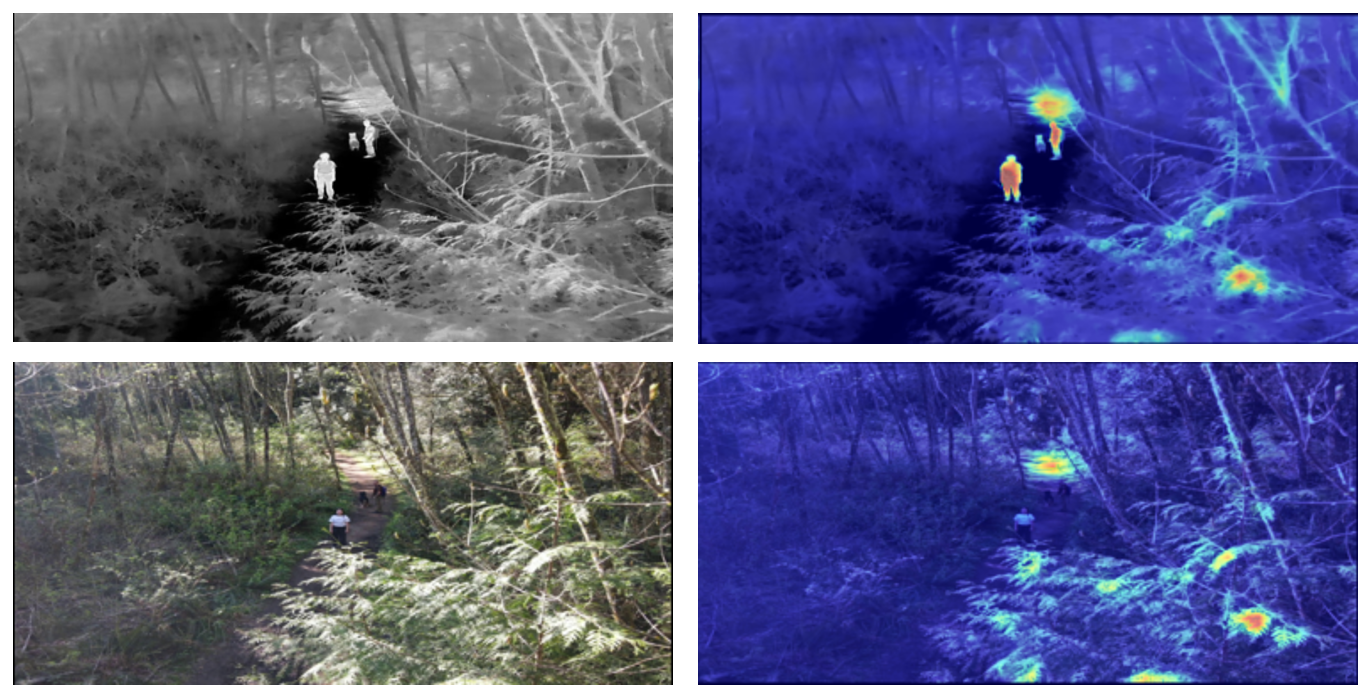 MISFIT-V: Misaligned Image Synthesis and Fusion using Information from Thermal and VisualA. Chauhan, I. Remy, D. Broyles, and 1 more authorAvailable at https://arxiv.org/abs/2309.13216, 2023
Detecting humans from airborne visual and thermal imagery is a fundamental challenge for Wilderness Search-and-Rescue (WiSAR) teams, who must perform this function accurately in the face of immense pressure. The ability to fuse these two sensor modalities can potentially reduce the cognitive load on human operators and/or improve the effectiveness of computer vision object detection models. However, the fusion task is particularly challenging in the context of WiSAR due to hardware limitations and extreme environmental factors. This work presents Misaligned Image Synthesis and Fusion using Information from Thermal and Visual (MISFIT-V), a novel two-pronged unsupervised deep learning approach that utilizes a Generative Adversarial Network (GAN) and a cross-attention mechanism to capture the most relevant features from each modality. Experimental results show MISFIT-V offers enhanced robustness against misalignment and poor lighting/thermal environmental conditions compared to existing visual-thermal image fusion methods.
2021
-
 Investigation of Temperature Distribution inside the Diesel Particulate Filter (DPF) during the Drop to Idle Test (DTIT) Performed at Steady-State and Worst-Case Driving CyclesRadhakrishnan Shankar, Aadhar Chauhan, Nandhakumar Krishnan, and 1 more authorSAE International Journal of Advances and Current Practices in Mobility, Apr 2021
The present work investigates the temperature distribution inside the diesel particulate filter (DPF) regeneration during the drop to idle test (DTIT), which is considered as life-threatening to the DPF. To study this scenario in detail, experiments were carried out with the filter volume of 3 liters. Initially, the experiments were done at a steady-state level, where the optimization for optimal soot loading was performed with setpoint temperature varying from 620 to 660°C. The soot loading was varied from 8 g/l to 11 g/l. The DTIT performed at a steady-state level indicated the different peak temperatures attained inside the DPF at different locations. The peak temperature was found to be in the center plane of the filter. The next peak temperature locations were found to be in downstream of the filter at different locations, which shows the non-uniformity in the soot deposition inside the filter. The temperature gradient was estimated based on the measured peak temperature and was higher at the center plane of the filter. The different soot loading and the setpoint temperature were correlated for different cases. The importance of selecting the optimal soot loading and setpoint temperature were discussed. The time taken from the start of idle speed to reach the peak temperature from the DTI test suggests the importance of the setpoint temperature, which is evident from the fact that it is promoting the burning rate of the accumulated soot with a higher setpoint. Decreasing the soot loading with relaxing the setpoint temperature can be a better option to operate the DPF in the safe zone and to avoid the failure of the DPF. A similar study was carried out at the vehicle level at different operating conditions. The temperature distribution inside the DPF in different worst-case driving maneuvers was measured.